Learning Erlang Programming
In a world dominated by mainstream programming languages such as Java, Python, and JavaScript, Erlang occupies a rather unique position.
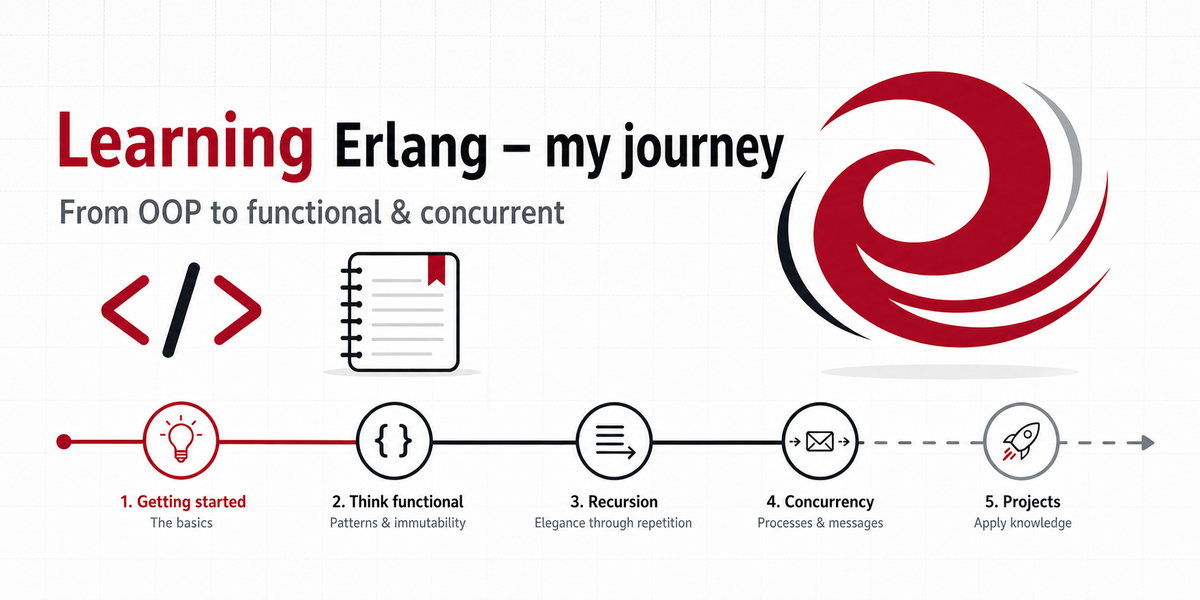
In a world dominated by mainstream programming languages such as Java, Python, and JavaScript, Erlang occupies a rather unique position. Originally developed at Ericsson for building fault-tolerant telecommunication systems, Erlang was designed with reliability, concurrency, and scalability at its core. These characteristics have allowed it to remain highly relevant in modern distributed systems, messaging platforms, and highly available backend infrastructures.
Learning Erlang is not only about understanding a new syntax; it is about adopting a different way of thinking about software design. Erlang encourages developers to build systems composed of many lightweight processes that communicate through message passing rather than shared memory. This actor-like concurrency model simplifies the development of systems that must handle thousands or even millions of simultaneous activities without sacrificing stability.
One of Erlang’s most remarkable strengths is its approach to fault tolerance. Instead of attempting to prevent every possible failure, Erlang embraces the philosophy of “let it crash.” Supervisors monitor processes and automatically restart failed components, enabling systems to recover gracefully from unexpected errors. This design principle has made Erlang a popular choice for applications requiring continuous uptime, including telecommunications, chat systems, distributed databases, and real-time services.
Another compelling reason to learn Erlang is its influence on modern software engineering. Concepts pioneered by Erlang have inspired technologies such as Elixir, actor frameworks, and resilient distributed architectures used throughout cloud computing. By studying Erlang, programmers gain deeper insight into concurrency, distributed computing, and functional programming paradigms that are increasingly valuable in today’s industry.
Although Erlang may initially appear unfamiliar to developers coming from object-oriented backgrounds, its minimalist syntax and functional nature can lead to highly maintainable and robust code. The language emphasizes immutability, recursion, and pattern matching, encouraging a clean and declarative programming style. Over time, many developers discover that Erlang changes not only how they write code, but also how they think about systems and reliability.
This journey into Erlang programming will explore the language fundamentals, its runtime environment, concurrent programming model, distributed system capabilities, and practical application development. Whether your goal is to understand fault-tolerant architectures, explore functional programming, or build highly scalable backend systems, Erlang offers a fascinating and rewarding learning experience.